(Image credit: Sony)
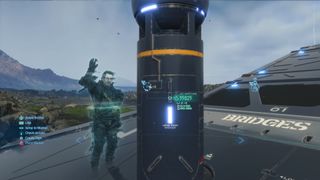
There's a moment in Death Stranding where I'm really, truly struggling to scale a snow-capped mountain in a blizzard. My exoskeleton legs have run out of juice; the boxes stacked on my back tower above my head and sway dangerously with every laboured step; my stamina is so low that Sam Porter Bridges regularly has to pause to catch his breath; and I'm all out of the critical Monster Energy Drink. It's around this time that I spy a Timefall Shelter and, right next to it, a generator – its lights glimmering like beacons through the white. They've been placed there by other users, other porters who have trodden this very route across this godforsaken mountain before me. They also just so happen to be the exact things that I need to save me – and my precious cargo – from absolute ruin.
Ever since Death Stranding was announced, creator Hideo Kojima has been pushing the idea that this is a game about connections, and regularly floats the idea that it's defining a new genre: the strand genre. Think what you want about the idea of Death Stranding defining a new genre – I certainly have a very complicated relationship with the game after countless hours of play – but it does, admittedly, do a good job of building connections between players, even though you'll never physically come into contact with another on your various journeys through the wilderness.

(Image credit: Kojima Production)
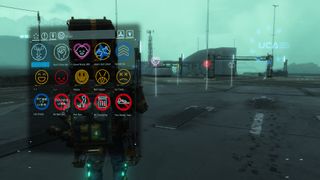
Asynchronous multiplayer isn't an entirely new idea, of course – the messages system in Dark Souls is a clear example of it being used successfully in the past. But it's Death Stranding's focus on aid, assistance and ultimately, positivity, which make it stand apart. In Dark Souls, you don't have to be helpful, but Death Stranding encourages you to assist and support wherever and whenever possible, to the point that the presence of other players shines through the bleakness of the game's environment as you move through it on your various, and numerous, journeys.
You can aid other players – and yourself, of course – in a number of ways. You'll gain a device called a PCC (Portable Chiral Constructor) early on in the game, a kind of fancy briefcase that lets you build a variety of different structures. To begin with, the things you can build are simple. You can construct a bridge to help cross rivers or rocky terrain, a watchtower to help you scan for enemy mules that might be looking to steal your cargo, and even a postbox that can be used to store goods in. As you progress through the game, you will have the opportunity to build structures that are even more useful. You'll be able to establish private shelters, ziplines to connect vast distances together, and even Timefall Shelters that will spring up like robotic trees to shield you from the ageing rain, repair your cargo, and give you a rare moment of respite.
(Image credit: Kojima Production)
Comments
Post a Comment
tnx for comment.